
The Biggest Digital Marketing Trends You Can't Ignore This Year
The Digital Marketing Trends That Are Reshaping How Businesses Connect With Customers in 2026
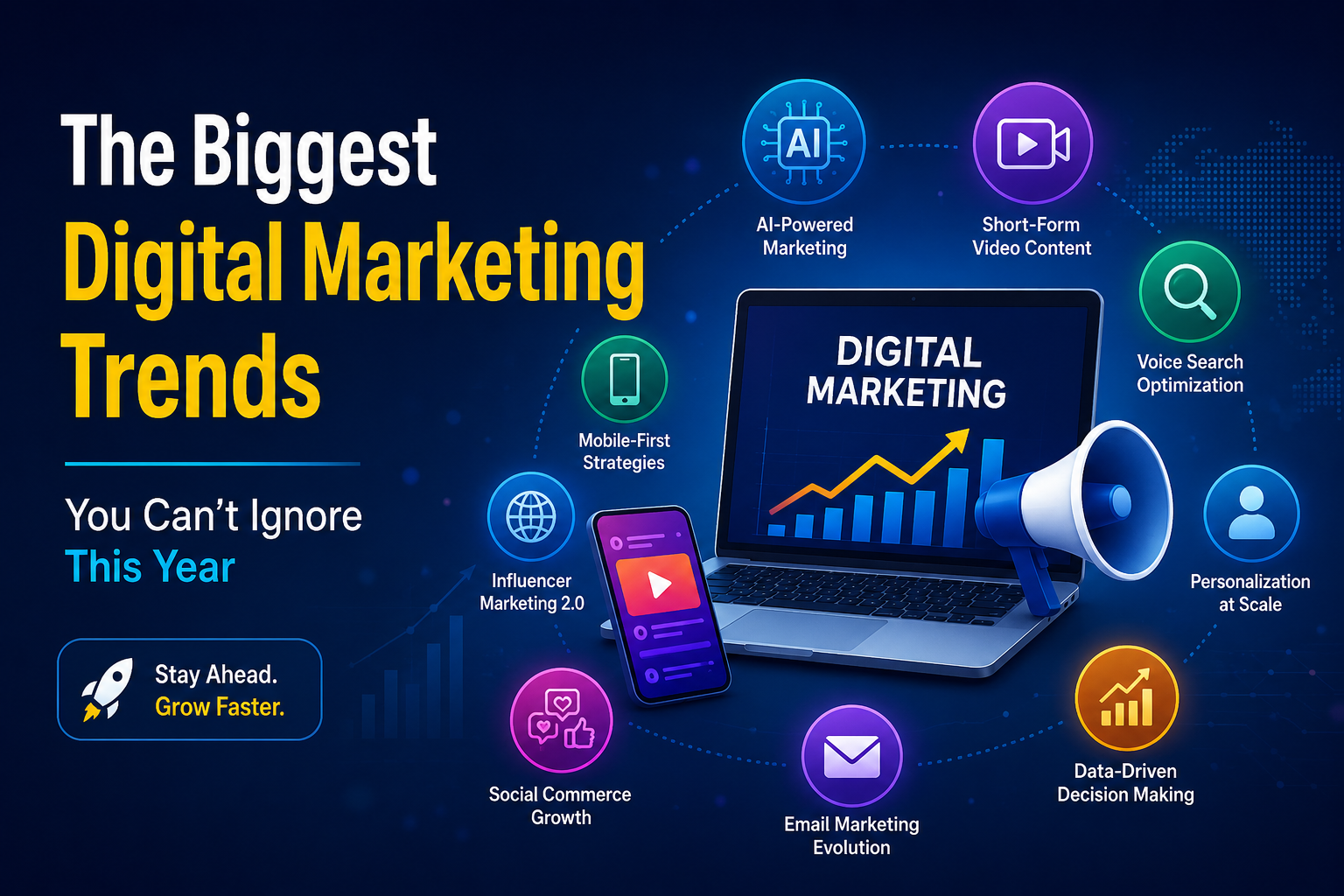
If you’ve been feeling like the rules of digital marketing are changing faster than you can keep up with, you’re not imagining it. The past year has brought shifts that go beyond minor updates or new platform features. The way customers search for information, how they decide to trust a brand, and where they spend their attention online has genuinely changed. And businesses that are still running the same playbook from 2021 are starting to feel it in their numbers.
I’ve spent a lot of time this year digging into what’s actually working for businesses right now, talking to marketers, reading through campaign data, and paying attention to what customers are saying about the brands they choose to support. What I found isn’t a list of shiny tools to adopt immediately. It’s a set of real shifts that require thoughtful responses, not panic-driven pivots.
This article covers six major areas where digital marketing is evolving in 2024. Some of these changes have been building for years and have now reached a tipping point. Others have surprised even experienced marketers. All of them matter if you want your business to continue growing in an environment where customer attention is harder to earn and easier to lose.
Table of Contents
- How Artificial Intelligence Is Changing the Way Marketers Work
- The Growing Importance of Short-Form Video and Visual Storytelling
- Search Behavior Is Shifting and SEO Strategies Must Adapt
- First-Party Data and Privacy-Focused Marketing Are Now Business Priorities
- Community Building and Authentic Customer Relationships as a Marketing Strategy
- Omnichannel Marketing and Meeting Customers Wherever They Are
I.How Artificial Intelligence Is Changing the Way Marketers Work
Let’s start with the topic that seems to dominate every marketing conversation right now. Artificial intelligence has moved from being something large enterprises experiment with to something that individual marketers and small business owners are using daily. But there’s a wide gap between how AI is being talked about and how it’s actually being used effectively.
AI-Powered Content Creation and What It Means for Marketing Teams
How AI Writing and Image Tools Are Being Used to Produce Content Faster
AI writing tools like ChatGPT, Claude, and Jasper have found a genuine place in the daily workflows of marketing teams. The most common use cases aren’t what the headlines suggest, though. It’s not about replacing writers. It’s about handling the time-consuming parts of content work: first drafts of product descriptions, summarizing research into bullet points, generating multiple headline options, or creating email subject line variations to test.
Image generation tools like Midjourney and Adobe Firefly are similarly being used to create quick concept visuals for social media or fill gaps when stock photos feel too generic. A small e-commerce brand, for example, can now generate lifestyle images for seasonal campaigns without hiring a photographer for every product variation.
The practical outcome is that teams with limited resources can produce more output without working longer hours. A two-person marketing team that once struggled to keep a blog and social media calendar running simultaneously can now maintain both.

Predictive Analytics and Smarter Customer Targeting
How AI Analyzes Past Customer Behavior to Predict Future Buying Decisions
Predictive analytics is one of those terms that used to belong exclusively to large companies with data science teams. That’s no longer the case. Many marketing platforms that small businesses already use, including Klaviyo for email, Shopify for e-commerce, and HubSpot for CRM, have built predictive features directly into their dashboards.
The basic logic is straightforward: if a customer bought a specific product, browsed a category three times, and opened emails about a related topic, the system can predict with reasonable accuracy when they’re likely to buy again and what they’re most likely to buy. This allows businesses to reach customers at the right moment rather than blasting the same message to everyone at the same time.
AI-Driven Personalization at Scale
Why Delivering Personalized Experiences to Thousands of Customers Is Now Possible
Not long ago, personalization meant putting someone’s first name in an email subject line. That still works, but customers have come to expect more. They expect a brand to remember their preferences, show them relevant products, and communicate with them in a way that reflects their history with that brand.
AI makes it possible to do this at a scale that would have required enormous manual effort just a few years ago. A single e-commerce platform can now dynamically change the homepage experience for each visitor based on their past behavior, showing different featured products, categories, and promotional banners depending on what the system knows about that person.
II. The Growing Importance of Short-Form Video and Visual Storytelling
Short-form video has gone from a trend to a standard expectation. If your brand isn’t showing up in video format somewhere, you’re missing a significant portion of how modern customers discover and evaluate businesses.
Why Short-Form Video Has Become the Preferred Content Format
A Look at the Data Showing How Audiences Consume Short Videos Versus Long Content
The numbers are hard to argue with. According to Sprout Social’s 2024 research, short-form video generates more engagement per post than any other content format across social platforms. Wyzowl’s annual video marketing report found that 91 percent of businesses were using video as a marketing tool in 2023, up from 61 percent in 2016.
More relevant than adoption rates, though, is how people actually behave with short video content. Viewers are more likely to share a 60-second video than a 1,500-word article covering the same topic. They’re more likely to rewatch it, more likely to comment, and more likely to remember the brand afterward.
Building a Consistent Video Presence Without a Large Production Budget
Low-Cost Tools and Equipment That Produce Professional-Quality Videos
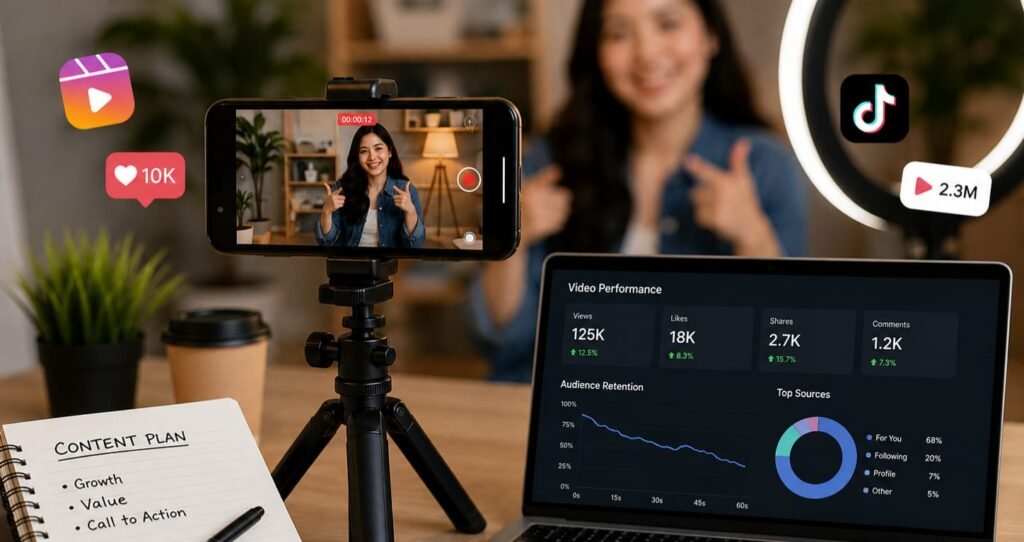
The production quality bar for short-form video is genuinely lower than most businesses assume. A recent-generation smartphone camera, a basic ring light, and a clip-on lapel microphone is all the equipment you need to produce videos that look and sound professional enough for any social platform.
For editing, tools like CapCut, InShot, and Adobe Premiere Rush offer mobile-first editing experiences that are intuitive enough to use without any prior video editing background. Canva has also built out video editing features that are accessible to anyone familiar with their design interface.
The investment to get started is under $100 for equipment and zero for editing software if you use free tiers. That removes budget as a valid reason not to start.
Measuring the Real Impact of Video Marketing on Business Goals
Key Performance Indicators That Actually Reflect Video Marketing Success
Views and impressions are the metrics that platforms push to the front of their dashboards because they make the numbers look impressive. But they don’t tell you much about whether video marketing is actually helping your business.
More meaningful metrics include watch time and completion rate (which indicate whether your content is actually holding attention), click-through rate on links included with videos, comments that reflect genuine engagement with the topic, and direct conversions from video-driven traffic.
III. Search Behavior Is Shifting and SEO Strategies Must Adapt
Search engine optimization in 2024 looks meaningfully different from what it looked like even two years ago. The way people search is changing, and the way Google presents results is changing even faster.
The Rise of Conversational and Voice Search
How People Are Searching Differently Because of Smart Speakers and Mobile Assistants
Think about how you naturally ask a question out loud versus how you type it into a search bar. Typing tends to produce fragmented queries: “best running shoes 2024” or “dentist near me.” Speaking tends to produce complete questions: “What are the best running shoes for someone with flat feet?” or “Which dentist near me accepts new patients on weekends?”
With roughly 35 percent of U.S. adults owning a smart speaker as of 2024, and virtually everyone carrying a phone with a voice assistant, the share of searches that come in conversational form is significant and growing. Mobile voice search has become especially common among younger users who find it faster than typing.
Search Generative Experience and the Future of Google Results
What AI-Generated Search Results Mean for Website Traffic and Visibility
Google’s Search Generative Experience (SGE), now evolving under the broader AI Overviews banner, places AI-generated answers at the very top of search results for many queries. The user gets a summary answer directly on the search page without needing to click through to any website.
For businesses that have relied on informational content to drive organic traffic, this is a real shift worth taking seriously. Early data suggests that some informational queries are seeing reduced click-through rates as users find what they need in the AI-generated answer box without visiting the source.
IV. First-Party Data and Privacy-Focused Marketing Are Now Business Priorities
The marketing industry is going through what I think is one of its most significant structural changes: the move away from relying on data collected by other companies about your customers, and toward building your own direct relationship with the people who buy from you.
What the End of Third-Party Cookies Actually Means for Marketers
A Clear Explanation of Third-Party Cookies and Why They Are Being Phased Out
Third-party cookies are small pieces of data placed in a user’s browser by a company other than the website they’re visiting. An advertising network, for example, might place a cookie when you visit a news article, track where else you go online, and use that behavior data to serve you targeted ads later.
They’re being phased out because regulators, especially in Europe and California, have determined that this kind of tracking happens without meaningful user understanding or consent. Major browsers have been responding: Safari and Firefox blocked third-party cookies years ago. Google Chrome, which holds the majority of global browser market share, has been in a phased process of restricting cookies and is moving toward more privacy-preserving alternatives.
Building a First-Party Data Strategy From the Ground Up
How to Collect Customer Data Directly Through Your Own Channels and Platforms
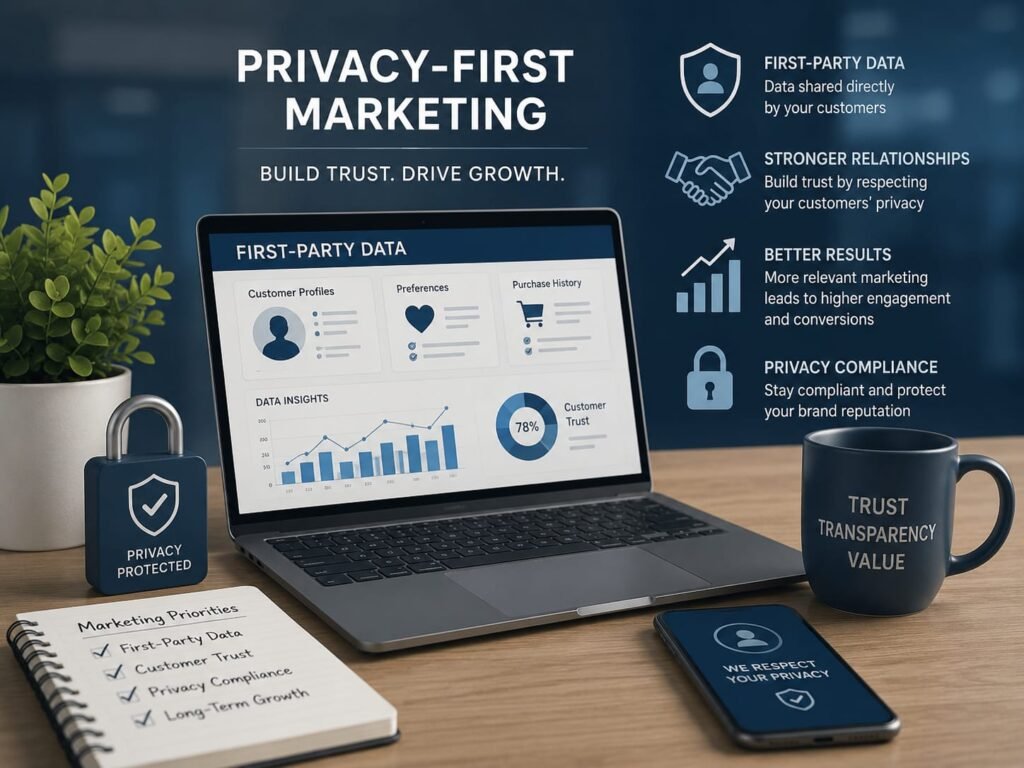
First-party data is any information that customers share directly with you through your own properties: your website, your app, your email list, your purchase history, your customer service interactions. Unlike third-party data, you own it, it reflects real interactions with your brand, and customers have chosen to share it with you.
The most fundamental way to collect it is through an email sign-up on your website with a clear and honest value exchange. Tell customers what they’ll receive in exchange for their email address, whether that’s a discount, helpful content, early access to products, or simply your regular updates.
Other collection mechanisms include post-purchase surveys, account creation on your website, quiz or assessment tools, and customer service interactions where preferences and needs are captured systematically.
Earning Customer Trust Through Transparent Data Practices
Why Customers Are Becoming More Selective About the Brands They Share Data With
Awareness about data privacy has grown considerably among everyday consumers, not just tech-savvy users. High-profile data breaches, discussions about how social media companies handle personal information, and increasing media coverage of privacy issues have made customers more cautious about the data they share.
This means the bar for earning someone’s trust enough to get their email address, let alone more detailed information, is higher than it used to be. Vague promises or buried terms of service don’t build confidence anymore. Customers want to know specifically what you’ll do with their information before they hand it over.
V. Community Building and Authentic Customer Relationships as a Marketing Strategy
Marketing has spent decades trying to reach as many people as possible. The direction that’s proving more effective in 2024 is building deeper relationships with fewer, more engaged people.
Why Branded Communities Are Replacing Traditional Audience Building
The Difference Between Having Followers and Building an Engaged Community
A follower is a passive relationship. Someone clicked a button once and your posts occasionally appear in their feed. They might engage, they might not. The algorithm determines whether they see your content on any given day. You have very little direct access to them.
A community is an active relationship. Members show up intentionally, talk to each other and to your brand, share their experiences, and feel some sense of belonging to something larger than a transactional exchange. They don’t need to be reminded that your brand exists because they’ve built it into their routine.
The distinction matters because community members convert at higher rates, refer others more frequently, and are significantly more forgiving when things go wrong, because they have a relationship with your brand, not just a vague familiarity with it.
Add Your Heading Text Here
Community members refer new customers at higher rates than passive followers or one-time buyers. When someone has a genuine positive experience with your brand and is part of a group of like-minded people who also value what you offer, word-of-mouth happens naturally.
Additionally, a community generates content, feedback, and social proof at no cost to your business. Members answer each other’s questions, share how they use your products, and post reviews and testimonials that reach their own networks. This organic activity effectively extends your marketing reach without additional spend.
Platforms and Formats Businesses Are Using to Create Online Communities in 2024
The options for building a community have expanded considerably. Discord servers, which were once primarily associated with gaming communities, have become a genuinely useful format for brands in creative industries, tech, and enthusiast categories. Facebook Groups remain active and practical, especially for businesses whose customers are already spending time on Facebook.
Private Slack channels work well for B2B businesses building communities around professional topics. Circle has emerged as a purpose-built community platform with better features than repurposed social networks. And for many businesses, the simplest and most durable community format is a well-run email newsletter with an active reply culture.

Summary
The six areas covered in this article represent genuine shifts in how digital marketing works in 2024, not theoretical future possibilities but changes that are happening now in the tools businesses use, the behavior of customers, and the rules that govern how data can be collected and used.
Artificial intelligence is changing how content gets made and how targeting works, but it doesn’t replace the need for real strategy and human perspective. Short-form video has become the default way audiences discover and evaluate brands, and it’s accessible to businesses of any size. Search behavior is evolving in ways that require content strategies built around genuine usefulness rather than keyword optimization alone. The end of third-party cookies is pushing businesses to build direct relationships with their customers through first-party data. Community building and authentic relationships are proving more durable than broadcast marketing. And delivering a consistent experience across every channel, online and offline, is no longer optional for businesses that want customers to trust them.
The thread connecting all of these shifts is a move toward more genuine, more direct, and more respectful relationships between businesses and the people they serve. That’s not a marketing technique. It’s a business orientation. And it’s the one that’s proving most durable in a market where customers have more choices and less patience than ever before.
Frequently Asked Questions (FAQs)
Do I need a large budget to keep up with these digital marketing trends?
No. Many of the tools and strategies covered in this article, including short-form video creation, first-party data collection, and community building, can be implemented with modest budgets. Prioritizing two or three areas relevant to your business is more effective than trying to adopt every trend at once
Which of these trends should small businesses focus on first?
Small businesses with limited resources should start with building a first-party data strategy and creating short-form video content. Both offer measurable returns without requiring significant investment in technology or staff
How does AI in marketing affect jobs for marketing professionals?
AI is automating repetitive and time-consuming tasks, but it does not replace the need for strategic thinking, creative judgment, or understanding customer relationships. Marketing professionals who learn to work alongside AI tools are likely to become more productive rather than replaceable.
What is the easiest way to start collecting first-party data?
The simplest starting point is an email list built through your own website, combined with a clear and honest reason for customers to sign up. From there, businesses can expand into surveys, loyalty programs, and gated content.
How can I tell if my current SEO strategy is ready for changes in search behavior?
Review how your content is structured and whether it answers specific questions clearly. If your pages are built primarily around short keywords rather than complete questions and answers, they may not perform well as conversational and AI-driven search continues to grow.
: Is influencer marketing still worth the investment in 2024?
Yes, but the approach has changed. Working with a small number of relevant influencers over a longer period produces better results than paying for one-time posts. Authenticity and audience alignment matter far more than follower count.